

Tenure: 1199 – 1278
Aradhana: Magha Shukla Navami
Location: Badarikashrama Pravesha
About Jagadguru Sri Madhvacharya
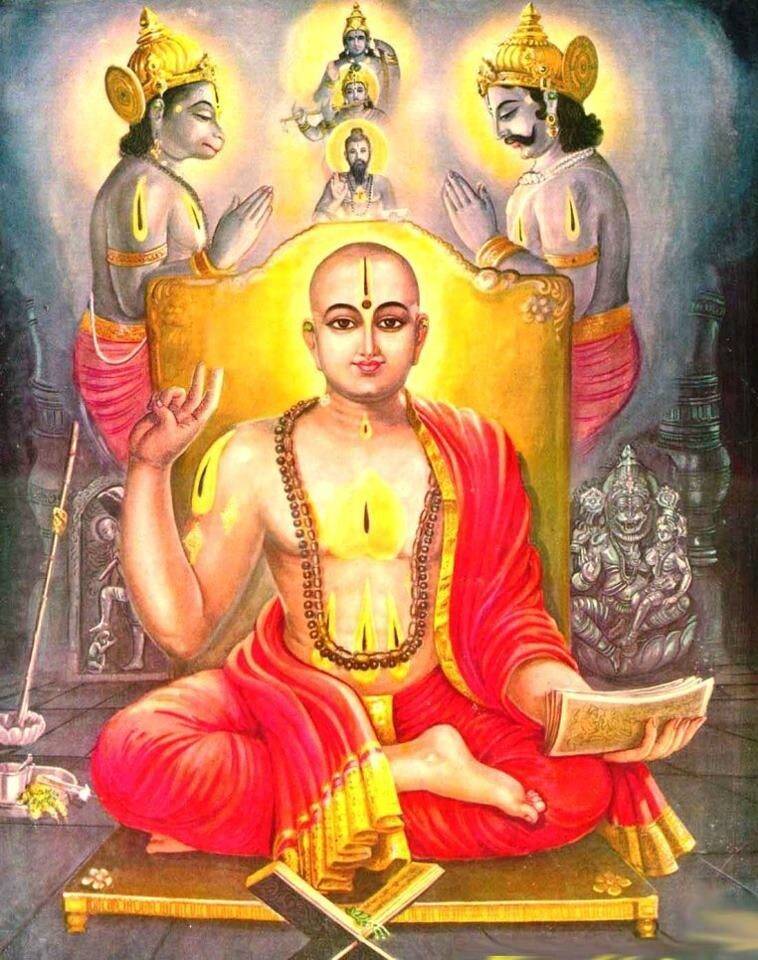
Acharya Madhva was born as Vasudeva to Madhyageha Bhatta and Vedavati at Pajaka Kshetra near Udupi. His ancestors were Tulu Brahmins belonging to the Bhagavata Sampradaya of Advaita Vedanta. The life of Acharya Madhva has been documented in the form of a fairly contemporaneous biography by Narayana Panditacharya that goes by the name Sri Madhva Vijaya and its contents further summarized in another work Anu Madhva Vijaya.
We understand from these works that Vasudeva had his Upanayana (sacred thread ceremony) early – by seven years of age – and had his early education at home from his father. He chose to adopt the fourth order – Sanyasashrama (life of renunciation) – in his teens, around sixteen years of age, from Sri Achyuta Preksha and was given the appellation Purnaprajna.
Purnaprajna undertook and completed a pilgrimage to important centers in South India along with his Guru and came back to Udupi and submitted it at the feet of Lord Ananteshwara. He then embarked on a pilgrimage to Badarikashrama after obtaining permission from his guru and received a call to visit Lord Vedavyasa and Badari Narayana. He submitted his Bhashya (commentary) on Sri Bhagavad Gita as an offering that was accepted and approved. Then Lord commanded Acharya Madhva to go back and compose a Bhashya on the Brahma Sutra for the benefit of devotees who need the right knowledge of Brahman as envisaged in scriptures, so that they could do their Sadhana, obtain His blessings, and attain salvation.
He then went back to Udupi and established the Krishna temple and composed the Sutra Bhashya. He toured around the country engaging in polemical debates to establish his new faith and gained converts from various parts of the country. He also composed additional works to put in place the fundamentals of his system as well as expositions of existing texts to firmly establish its concepts.
He then undertook one more pilgrimage to Badarikashrama and obtained the Vyasa Mushtis from Lord Vedavyasa and was commanded to write a Nirnaya on the Mahabharata, which he did with elan.
He was endowed with many disciples and ordained his own Purvashrama brother and a few others into the fourth order, each special in their own way, who took different responsibilities in furthering the path shown by the Acharya to the common people. Eight of them then took the responsibility of worshipping Krishna in Udupi by turns – including his own brother – while converts from other parts of the country started on a propagation mission.
Having achieved the purpose of his birth, Acharya disappeared from human sight while giving a discourse at the Ananteshwara temple.
Introduction
Philosophy tries to answer the fundamental questions on the purpose of human existence: what we see, the reason for each and everything that happens around us, and the relationship that we have with all those entities. Indian philosophy is perhaps the oldest existing living example in the whole world.
At a very high level, Indian philosophy admits a wide variety of thought processes, the general theme being some or all of the following: the presence of souls that undergo transmigration – births and deaths – and the existence of a liberated state of permanent bliss. The goal of human life is to work one’s way through transmigration to attain this state, and philosophy provides ways and means to be followed in life to reach this state.
Existing philosophical literature is vast, having accumulated over centuries, but is classified under two heads: the Shruti – revealed – and Smriti – composed. The Vedas fall under the category of Shruti while Itihasas and Puranas are classified as Smriti. The Ramayana and Mahabharata are the Itihasas while there are eighteen Puranas starting from the Srimad Bhagavata. All the scriptural literature that evolved in the subcontinent is in Sanskrit – one of the few surviving classical languages in the world – complete with its own grammar, etymology, and related rules.
The thought processes – Darshanas – that developed in the subcontinent can be classified as Astika or Nastika based on their belief and acceptance of Shruti as the authority to provide answers. Systems that don’t accept the Vedas are called Nastikya Darshanas – Buddhism, Jainism, etc. – while those that accept the Vedas as authority are Astikya. There are six schools – Shad-darshanas – listed under the latter: Nyaya, Vaisheshika, Sankhya, Yoga, Purva Mimamsa, and Vedanta or Uttara Mimamsa.
Another prominent aspect in Indian thought is the existence of six religions – Samaya or Mata – Shaiva, Vaishnava, Shakta, Ganapatya, Skanda, and Saura. Each of these have their own Agamas – or religious codes of conduct for ritual worship – and are detailed in their exposition. Some of these concepts can be contradictory to those expressed in the Vedas. This raises questions about their relationship and their relative positions within the philosophical framework.
Purpose of Advent
Acharya Madhva is one of the three prominent Vedanta Acharyas – Shankara and Ramanuja being the other two. For establishing one’s school of Vedantic thought, the Acharya had to compose commentaries on the Prasthana Traya (principal triad) – comprising the Upanishads, Bhagavad Gita, and Brahma Sutra. Acharya’s Vedanta is referred to as Tattvavada or more commonly as Dvaita, and is the last of the three.
Knowledge on Brahman lies scattered in scriptural literature and can be bewildering even to the traditionally schooled – “Asta Vyastam Samasta Shrutigatam Adhamai Ratna Pugam Yatandai.” The Brahma Sutra composed by Lord Vedavyasa provides guidelines to interpret the sacred literature, obtain right knowledge about Brahman, perform Sadhana, and outlines the fruit of this Sadhana.
Before the advent of Acharya Madhva, there existed 21 incorrect understandings of the Sutrakara’s opinion. Hence, Acharya was commanded by the Lord to descend to earth and provide the right understanding so that good people could be redeemed.
The most important contribution of Acharya Madhva to Vedanta is the harmonization of thought processes on Brahman existing in sacred literature. Tat Tu Samanvayat is indicated by the Sutrakara in his fourth sutra. Acharya demonstrated how this can be achieved by composing thirty-seven works collectively referred to as Sarvamula Granthas. Some of these were commentaries (Bhashyas) on the Prasthana Traya, some were his own compositions serving as foundational texts of his school (Dashaprakaranas), some were verses for worship and rituals, some were compilations of important quotes from sacred literature, and others.
Acharya Madhva identified himself as Mukhyaprana or Vayu Devaru – presiding deity of the primordial breath of the Upanishads. He openly declared in a couple of his compositions that he came as Hanuman to serve Lord Rama and as Bhima to serve Lord Krishna. He was commanded by the Lord to descend to earth and provide the right knowledge to deserving souls so that they worship Him, earn His grace, become liberated from transmigration, and enjoy their innate permanent bliss. Hence, he descended as Madhva to execute Lord Vedavyasa’s command. The Balitta Sukta of the Rig Veda describes his three forms.
Unique Contributions
Some key contributions of Acharya Madhva’s philosophy (Tattvavada):
- Purusha, Brahman of the Upanishads, is none other than Narayana (Vishnu).
- He is perfect and flawless in all respects.
- He is the only independent entity; all others are fully dependent on Him.
- There is no difference between the various forms of the Lord.
- Mula Prakriti of the Upanishads is presided over by Lakshmi (Sri Tattva) and is threefold in nature – Sattva, Rajas, and Tamas gunas.
- Purusha and Prakriti exist always (Anadi) and serve as intelligent (Nimitta) and material (Upadana) causes for the world.
- Though eternal, Prakriti is always dependent on Purusha.
- Chaturmukha Brahma is the first of the created jivas and the presiding deity of the first evolute – Mahat Tattva.
- Other evolutes like Ahamkara are presided over by their own deities (e.g., Rudra for Ahamkara Tattva).
- This order of evolution establishes Taratamya in Tattvavada.
- Each jiva is unique and distinct.
- Jivas are classified as Sattva, Rajas, and Tamas, explaining differences in behavior.
- Inanimate objects are also unique, setting up the five primordial differences (Pancha Bheda).
Process of Sadhana
The seeker (sadhaka) begins by clarifying doubts with a guru. The guru puts him through discipline involving listening (Shravana), performing duties (Nitya Karmanushtana), and contemplation (Manana). This cycle of knowledge, action, and contemplation elevates the soul. Over births, this deepens until every action becomes worship of the Lord, leading to cleansing, grace, and liberation.
Sarvamula Granthas
Acharya Madhva composed thirty-seven works, collectively known as Sarvamula Granthas. These include:
- Commentaries on Prasthana Traya – Dasopanishad Bhashya, Gita Bhashya, Gita Tatparya, Sutra Bhashya, Anuvyakhyana, Nyaya Vivarana, Anu Bhashya.
- Dashaprakaranas – foundational texts outlining his philosophy (e.g., Pramana Lakshana, Katha Lakshana, Mayavada Khandana, Tattvodyota).
- Itihasa-Purana Tatparya Nirnayas – commentaries on Ramayana, Mahabharata, and Bhagavata.
- Other unique works like Rig Bhashya, Tantrasara Sangraha, Ekadashi Nirnaya, Krishnamrita Maharnava, Sadachara Smriti, Yati Pranava Kalpa, and devotional stotras like Dvadasha Stotra and Nrisimha Nakha Stuti.
Though Saint Achyuta Preksha gave Vasudeva the ashrama name Purnaprajna, he is known by many names: Dashapramati, Madhva, Anumana Tirtha, Sukhatirtha, Anandatirtha.
Gallery